
The Code of Conduct is designed to promote the goals of the Nepean Artistic Swim Club (NASC)
In our climate, we can have numerous days of inclement weather during the season. If the pool facility remains open, we endeavor to continue to provide pool time and coaching as usual. Ultimately, it is up to
the parents of our swimmers to decide if they feel it is safe to transport their child during periods of inclement weather.
If we are not able to provide a safe swimming environment for the swimmers by supplying sufficient coaches and/or lifeguards, the session will be cancelled. Families, athletes and coaches will be notified via EMAIL by a Board Member, Head Coach or Lead Coach if:
The club will also try to post on social media(Facebook, Instagram). However, as the prime communication is EMAIL, parents, athletes and swimmers should monitor email on a REGULAR basis when inclement weather has been forecasted .
The Club will endeavour to give at least 4 hours notice for practices in the afternoons and evenings and night before for early morning practices.
Sessions that are cancelled due to inclement weather will not be rescheduled , and no refunds will be given.
The table shows the primary and secondary notifiers for weather cancellations for each stream.
To be considered FULLY registered in one of the Club’s programs, participants must complete a three(3) step process:
Once a participant has completed these three steps, they are considered FULLY registered with the Club. No swimmer will be allowed to start their program until all online registration is complete and fees are paid.
Fees for all of our programs can vary from year to year due to a multitude of factors, which are, but not limited to:
In addition to this information, below you can find more details on fees for each of our programs
These programs have three(3) different fees: Commitment, Registration and Competition.
These programs require a $300 mandatory non-refundable Commitment Fee at the time of registration. An athlete will NOT be considered registered with Club until this fee is received. In addition, the athlete will not be eligible to attend the Club’s mandatory start-of-season training camp for their stream until payment is received.
Once training camp and team selection is complete, the Board finalizes fees for these programs.
These fees include(but not limited too), for both team and extra routines:
Invoices are usually sent out mid-late September and can be paid in two equal installments. This first 50% is usually due around October 1st, second 50% around December 1st.
The $300 Commitment Fee is considered part of the Registration Fee and is deducted from the amount owing for registration. For example, if the Registration Fee was $2000, the amount owing would be $1750.
These fees, for the most part, cover the cost of competitions, but also a few other items and include, but not limited too:
These fees are also collected over two(2) installments, 50% around February 1st and 50% around April 1st. The fees published for these at the beginning of the season are estimates, based on previous experience, type of travel, program and program age group. Should the estimate be too low at the end of the season, an additional invoice will be issued. Should the estimate be too high, a refund can be requested or the credit can be applied to next season. Detailed invoices will be provided as soon as possible once final meet costs are calculated.
NASC has an ongoing commitment to its members in its recreational programs. As a not-for-profit corporation, our annual fees for recreational swimmers are based on all anticipated costs, to be borne fairly and proportionately among members. As such, a commitment to swim also results in associated financial commitments. Specifically, the refund policy is as follows:
All recreational swimmers must register on-line and agree to all NASC waivers and permission forms prior to participating, as well as complete the OAS H20 online registration.
A non-refundable deposit of 50$ is due at time of registration. No swimmer will be allowed to start a class until all waivers are signed and payment has been accepted. Exceptions may be made if discussed ahead of time with the club treasurer.
For full-season recreational programs, 50% of the remaining cost will be invoiced in September prior to classes starting and the final 50% will be invoiced at the start of November.
The fees for 12-week programs and recreational summer synchro programs are non-refundable after the start of the program and will be invoiced in full (less registration deposit) in September before classes begin. The fees cover coaching and pool costs, and mandatory registration fees and insurance with Ontario Artistic Swimming.
The full season programs are between 1.5-4hrs per week. The fees for these programs include the routine suit and all gelling, hair and make-up supplies for the season end Watershow, coach and pool costs, mandatory registration fees and insurance with OAS. Full refund minus $100 administration costs will be given within the first 3 classes. 50% refund minus $100 administration costs will be given between the 3rd and 6th class. No refunds will be given after the 6th class.
Refunds will be given on a pro-rated basis for medical reasons, with proper documentation and on a case-by-case basis.
There are no refunds for canceled practices due to weather or pool cancellation. All efforts will be made if a class is canceled to make up the class. This will depend on pool availability and is not guaranteed. Classes missed by individual swimmers will not be able to be made-up as teams are all very unique in what is being practiced, depending on the levels and swimmers.
Late registrations will not be prorated.
There are no refunds for missed or canceled practices.
As previously mentioned, the Commitment Fee is non-refundable.
If an athlete chooses to withdraw up to and including August 31st, there are no further fees required, other than forfeiture of the aforementioned Commitment Fee. In addition, any financial commitments the Club has made on behalf of the athlete (including but not limited to travel, meet fees, routine suit, clothing) will be due immediately.
If an athlete chooses to withdraw due to an extraordinary circumstance (i.e., injury or serious illness) up to December 31st, an appeal can be made to the Board of Directors. Any refund will be determined at the discretion of the Board of Directors. There is no guarantee a refund will be granted. After December 31st, no fees will be refunded. In addition, any financial commitment the club has made on behalf of the athlete(including but not limited to travel, meet fees, routine suit, clothing will be immediately due.
In the case of any athlete being asked to leave the Club by decision of the Head Coach and Board of Directors, fees will be prorated up until December 31st. No refunds will be issued for decisions made after December 31st. In addition, any financial commitments the club has made on behalf of the athlete including, but not limited to, meet fees, travel costs and routine suit will be immediately due.
There are no refunds for missed or canceled practices. If a practice is canceled, all efforts will be made to make it up pending pool and coach availability.
Should the participant completely withdraw from the program for whatever reason, refunds will be given on a prorated basis for medical reasons, with proper documentation.
Late registrations will not be prorated.
Online Interac E-transfer is the PREFERRED method of payment for the Club.
Please send the e-transfer to treasurer@nepeansynchro.com.
A password is no longer required from most banks.
Please include your athlete’s name in the comments section of the e-transfer.
For more information on Interac e-transfer see http://www.interac.ca/en/interac-e-transfer-consumer.html
The Club can also accept cheques.
Please write the following on the cheque:
Payable to Nepean Artistic Swim Club
Athlete’s name
Season you are registering for ( example: 2022-2023 )
Name of program you enrolled in ( example: Comp/Novice/Rec/Masters/AWD)
Cheques may be mailed to the Club Treasurer at:
14 Denham Way
Stittsville, ON, K2S 1H6
Last Updated: June, 2024
Nepean Artistic Swim Club Anti-Bully Policy - Last Update September, 2019
This protocol must be followed whenever an athlete has an injury which requires them to modify activity for
more than ONE WEEK or requires them to modify activity within the BLACKOUT PERIOD leading up to a
competition.
Step 1: Seek professional advice and get them to fill out the Nepean Artistic Swim Club Functional Abilities Form (FAF), then hand it out to your coach(es). Ask for recommendations about what the athlete can do
at/outside of the pool to help with recovery (ex. Specific exercise program, posture correction, find short term
functional goals in accordance to a gradual progression of activity, etc.).
Step 2: Follow up on recommendations – athlete/parent must update coach(es) on progress once a week to
ensure successful recovery and reintegration into practices.
Step 3: Increasing participation in practices based on successful recovery of injury and suggested timeline
from medical professional (ex. Moving from on land activity, to in water activity out of pattern, to in water
activity in pattern).
Step 4: Full return to practice with no restrictions. Athlete must pass a specific screening tool provided by their
coach(es) and a signed note from their medical professional must be provided to reach stage 4, except where
the note provided in step one includes a full timeline for recovery and the timeline has been met.
Notes regarding injuries during a blackout period:
If an injury occurs or continues into the blackout period, a meeting is required between parents, the athlete,
team coach(es), a head coach and a board member to discuss the athlete’s participation in the upcoming
meet.
If an athlete has not reached Step 4 within two weeks of the competition, the athlete will be scratched for the
upcoming meet.
An exception may be made if an athlete is able to participate in >75% of regular training activities and has
approval for participation in a competition by a medical professional. The final call will be made by the Head
Coaching team and may involve partial participation in the competition (i.e. figures only).
Other notes:
Nepean Artistic Swim Club Return to Sport Injury Protocol – Last Update September, 2019
The Head Coaching team has the right to make final decisions concerning an athletes’ participation in artistic
swimming activities during and post-injury.
It is the athlete and parent’s responsibility to inform coaches of injury as soon as possible so that the proper
steps are taken to ensure maximum health of the athlete.
During injury, athletes are expected to attend ALL practices (either in the water or on land) unless otherwise
advised by a medical professional. Exceptions may be made at the discretion of the Head Coaching team.
The Head Coaching team recognizes that each case is different and will take into account all factors before
making any final decisions.
Medical Professional includes sports medicine doctors, physiotherapists, chiropractors, athletic therapists,
massage therapists.
Nepean Artistic Swim Club recognizes mental health benefits and risks inherent to competitive sport. We strive to create a sport environment that is positive, task-oriented, and develops the mental strength and skills of our athletes. Similar to physical injury, mental health symptoms can impede training and cause unsafe training environments in a sport where athletes are at risk of injury when those around them cannot perform to the demands of training. NASC aims to support any athlete experiencing mental health challenges by supporting them to stay in sport as much as possible while working with appropriate health professionals towards recovery and management of symptoms.
While this protocol provides guidance for coaches and athletes, it does not constitute medical advice and athletes should follow the instructions of their doctor or another medical professional.
Mental Health: a state of well-being in which the individual realizes their own abilities, can cope with the normal stresses of life, can work productively and fruitfully, and is able to make a contribution to his or her community (WHO).
Mental Illness: persistent and substantial deviation from normal functioning that impairs the ability to execute social roles and generates emotional suffering.
In cases where mental health challenges are suspected or reported, the coach is required to disclose these to a parent. The coach and head coach will also make a recommendation for an appropriate level of services.
Services may include a Mental Performance Consultant (MPC), Registered Counsellor or Psychotherapist, or Licensed Clinical Psychologist. Recommendations should be made according to the severity of the symptoms of the athlete. See figure 1 below for help selecting an appropriate service for the athlete.
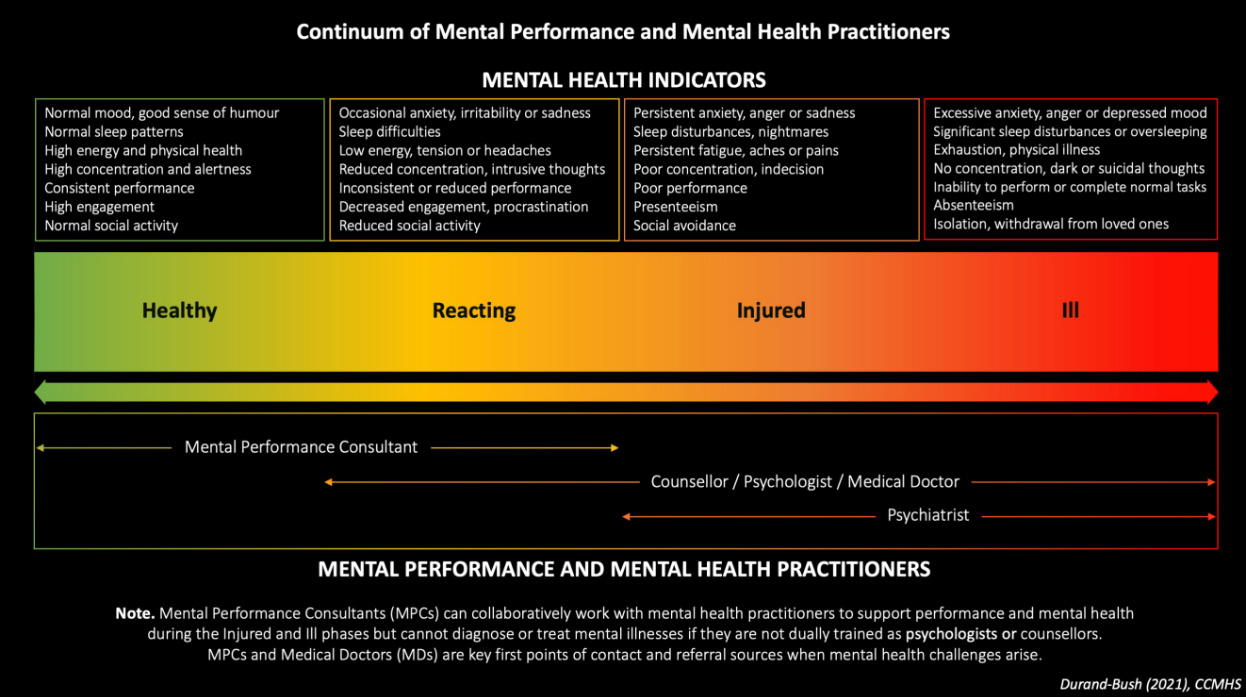 Figure 1
If challenges occur or continue into the cutoff period, a meeting is required between parents, the athlete, team coach(es), a head coach and a board member to discuss the athlete’s participation in the upcoming meet.
The final decision regarding competition participation will be made by the Head coaching team and will be dependent on case-by-case factors such as the ability to complete the full routine and figures safely, the athlete’s participation in training, and the ability to follow the Code of Conduct while travelling and competing with the team. The decision may also include approval and recommendations from a medical professional. Possible decisions may involve partial participation in the competition (i.e. figures only), full participation, or a recommendation that the athlete does not participate or travel with the team.
Please note that this list is non-exhaustive, but may give swimmers and families a starting point when seeking help.
Canadian Sport Psychology Association: https://www.cspa-acps.com/find-a-consultant
Psychology Today: https://www.psychologytoday.com/ca/therapists/on/ottawa
Westboro Psychology: https://www.westboropsychology.com
Drice Psychotherapy: https://www.dricepsychotherapy.com/team
Barrhaven Psychological Services: https://www.barrhavenpsychservices.ca
Red Oak Psychotherapy: https://www.redoakpsychotherapy.com
Juniper Counselling Centre: https://www.junipercounselling.ca
Ottawa Academy of Psychology: https://ottawa-psychologists.org/online-directory/
1 Call 1 Click: https://1call1click.ca/en/index.aspx
Kids Help Phone: https://kidshelpphone.ca/
PLEO: https://pleo.on.ca/ (support for parents of children dealing with mental health challenges)
OAS Safe Sport Page: https://ontarioartisticswimming.ca/safe-sport/
CHEO Mental Health Resources: https://www.cheo.on.ca/en/resources-and-support/a-z-resources-mental-health.aspx
NASC November 2023
Additional policies from Ontario Artistic Swimming and Canada Artistic Swimming that apply to all member clubs can be found here.
What you’ll need (covers at least 1 head + touch ups):
You may prepare a smaller or larger quantity of gel by using the ratio of 4 packets of gel to ⅓ cup water. Leftover gel may be frozen and defrosted on counter and reheated for re-use.
Empty 12 packets of Knox gelatin into appropriately sized slow cooker or small round Ziploc container and then add 1 cup lukewarm tap water. SLOWLY and very gently stir the water and gel powder with a spoon. (Stirring slowly is key to avoiding unwanted bubbles and foam from developing during the mixing process). The mixture will be thick, clumpy and white.
Slow cooker method: Prepare as above, turn on heat, cover and leave for two hours, until melted and clear. Use immediately, leave in slow cooker and reheat when needed or pour into plastic container for later use. If time between preparation and use is more than a day, then store in refrigerator. If making well in advance (e.g., for the season), you can freeze the gel in Ziploc containers.
Simmering pan method: Prepare as above, place container in pan of simmering water on the stove. Stir gently, occasionally. Mixture will gradually clear from the bottom up and be yellow-brown in colour. When clear (looks like chicken stock), remove to counter and let sit 10 minutes or so. Skim off whitish film/bubbles from top. (Letting it sit 10 minutes on the counter causes this to form into a skin on top, so it’s easier to remove). May be used immediately or put aside and stored for later use. If time between preparation and use is more than a day, then store in refrigerator.
How to use the pre-prepared gel: Remove lid from container of gel; if frozen, defrost on counter. If using a mini slow cooker, place gel directly into slow cooker and turn it on; it will take a minimum 1.5-2 hours to melt gel and heat to the desired temperature. To decrease time needed, microwave gel in container until liquid and hot and pour into mini slow cooker to keep warm for use. If it cools and thickens during gelling, simply place container in the simmering water for a few minutes or in the microwave for 10-15 seconds. If heating multiple containers of gel in a large slow cooker, bring an inch of water to simmer in bottom of slow cooker and place containers of prepared gel in the water.
Recommendation:
Prepare your gel a few days before it is needed – refrigerate if preparing several days ahead. This is especially handy for early morning gelling sessions. When you are ready to do your hair, melt the gel slowly as indicated above – you will need at least 1.5-2 hours to melt the gel if you are taking it from the fridge and using the slow cooker. The slow cooker is a preferred method for preparing and melting the gel because it produces no foam/bubbles. Multiple containers can be stacked in the slow cooker for heating at the same time. (The slow cooker is portable too – take it to the pool!) Containers of gel may also be left in the slow cooker with their lids on. During application, should the gel start to cool and thicken, simply exchange the container for one from the slow cooker and continue your application, rotating containers as necessary to ensure you are always using the best (most fluid) gel, until the job is done.
Alternate “Kettle method” (from an ‘insider’ coach who prefers this)
This method is quick, uses less gel packets per head, and is a great option at competitions where slow cookers are not allowed and the only ingredient provided in the designated gelling room is hot water.
Needed:
For base coat / watery coat
For top coat / thicker coat:
The ultimate secret to a successful gel job is the preparation of the swimmer’s hair before the gel is applied. Ensure the hair is slightly damp, pull it into a very smooth tight ponytail (no lumps or bumps; ponytail in line with the top of the ears) and then divide into 3 or more braids, depending on the thickness of the hair. Wrap the braids and pin (using open hairpins) snugly into a tight bun; cover the bun with a hairnet and/or bun cover. For sensitive skin, you can apply Vaseline just in front of the hairline. If you have wisps of stray hair, dampen the hair a little more to control ‘wispies’ before the gelling steps.
Apply gel generously (but not too thickly), starting from just in front of the hairline and brush towards the bun in smooth even strokes. If any water gets past the hairline, you run the risk of the hair coming loose in the pool. Two to three thin coats will be more effective than one thick coat of gel. Let gel dry to a tacky state between coats. If using a headpiece, pin it in when the top coat of gel is still tacky.
The best time to remove gel is when it’s still wet, so if the gel has had time to dry standing in the shower for a few minutes will loosen it up again.
A few notes and tips on removing gel:
Good Luck!
Routine suits are the custom made suit worn only at shows and competitions. They are more fragile than a regular Speedo type practice suit and therefore extra care is required. They need to continue to look good until the end of May and are not to be worn for anything other than a water show or competition unless otherwise told by your coach.
Please follow the care guidelines below carefully. Otherwise, the routine suit will fade and not look the same as the rest of your team’s suits. If you find any sequins on the suit have come loose after a competition, please sew them back in place before the suit is worn again.
Below you will find a fact sheet that you can review by yourself and with your child. It provides you and your child with the most up-to-date information on puberty and menstruation. If you have more questions, there are some links to trustworthy websites and links to additional resources of puberty. You will notice that this information is written in a gender-neutral format and there is a section on transgender and non-binary folks and menstruation. At the end, you will find all the diagrams for reference.
Key Messages:
Mensuration- aka having your period — is when blood and tissue from your uterus comes out of your vagina. It typically happens every month or every 21-35 days (about 1 month 4 and a half days), the average being about 28 days (about 4 weeks).
Typically, people with ovaries begin to menstruate between the ages of 9 to 15. The average age is around 12 years old in North America. Some people begin to menstruate before 9 and some people menstruate a little later. This is typical for you. If you are 16 and have not started your period, you can talk to your nurse practitioner or family doctor.
Most people will begin menstruation 2 to 3 years after the development of breasts and 6 to 12 months after the appearance of cervical mucous. People typically start to grow pubic hair on their underarms and vulvas between 7 to 15 years old.
Most people will continue menstruating until they are 45-55 years old. This is called menopause. The cycle of menopause can last 7 to 14 years.
Your menstrual cycle helps your body prepare for pregnancy every month. It also makes you have a period if you are not pregnant. Your menstrual cycle and your period are controlled by hormones called estrogen and progesterone.
(Planned Parenthood, 2022, https://www.plannedparenthood.org/learn/health-andwellness/menstruation)
Not everybody who gets a period identifies as a girl or woman. Transgender men, nonbinary and genderqueer people who have uteruses, vaginas, fallopian tubes, and ovaries also get their periods.
Having a period can be a stressful experience for some trans folks because it’s a reminder that their bodies don!t match their true gender identity — this discomfort and anxiety are sometimes called gender dysphoria. Other trans people might not be too bothered by their periods. Either reaction is normal and okay.
Sometimes trans people who haven!t reached puberty yet take hormones (called puberty blockers) to prevent all the gendered body changes that happen during puberty, including periods. And people who already get periods can use certain types of birth control (like the implant or hormonal IUD) that help lighten or stop their periods. Hormone replacement therapy, like taking testosterone, may also stop your period. If you start taking testosterone, your period will go away. But this is reversible — if you stop taking testosterone, your period will come back. There can be some changes in your menstrual cycle before it stops for good. Periods get lighter and shorter over time or come when you don!t expect it. You may have spotting or cramping occasionally, until
you stop getting your period, and sometimes even after it seems to have stopped — this is normal. Testosterone injections make your periods go away faster than testosterone cream.
If you experience gender dysphoria when you get your period, know that you’re not alone. It may be helpful to check out our resources and find a trans-friendly doctor in your area that you can talk to.
(Planned Parenthood, 2022, https://www.plannedparenthood.org/learn/health-andwellness/menstruation)
Your first period can last anywhere from 2 to 7 days. It may be very light, with just a few spots of brownish blood. Or it may start and end more brownish but be brighter red on heavier flow days. It is typical to have your period one month and then not the next at first. After a couple of cycles, you will notice you begin to have more red blood.
(SOGC, 2022, yourperiod.ca)
A couple of days before your period you may notice a couple of different things. You may notice you are feeling more irritable, hungry, and tired. You may also experience lower abdominal cramping, breast tenderness, lower backaches, diarrhea or nausea or dizziness. You may also notice skin changes such as pimples.
You have probably heard of pre-menstrual syndrome (PMS). PMS differs for each person and affects each person differently. Societally, anger and irritably that women and female presenting folks express are often chalked up to PMS. While PMS can make people feel more irritable, anger is a normal emotion and is often a normal response to a situation that has made you upset or frustrated. Labelling anger that women and female presenting folks express as PMS is a direct result of sexism.
Periods come monthly, but this can vary a whole lot at the beginning. Write the date of your period on the calendar so you can keep track and learn how to predict it. Day one is the first day you see blood. There are many apps for your phone that track and predict your next period. Some of these apps sell your information to third parties and you must purchase. Here is a list of period tracker apps that do not store your personal data and does not use third party trackers: Clue, Drip, Euki, Periodical
Periods may be irregular at first, lasting 3 or 8 days. Typical blood loss is 5-6 tablespoons. Blood flow on the first day tends to be light, heaviest on day 2 or 3, then lighter the next few days until it stops. There are different products you can use to manage your period such as menstrual cups, period underwear, pads, and tampons.
Painful symptoms such as cramps, backache, and tender breasts can usually be relieved by over the counter, anti-inflammatory pain relievers such as ibuprofen or naproxen.
Prescription medications (such as Ponstan) are also available. Warm baths or compresses can be useful to alleviate cramping. Constipation can make the cramps far more intense, and the hormones in the latter half of the menstrual cycle do increase constipation. Plenty of fluids, high fiber foods or a simple bulk forming stool softener such as psyllium can relieve pain.
(SOGC www.yourperiod.ca)
You may feel like you need to lay down or may need more sleep when you have your period, but it is not typical to be physically unable to function due to period pain. If you find that your periods are difficult to manage, or they seem worse than what is described, it is time to see your doctor or nurse practitioner and request a consultation with a gynecologist that sees youth. Abnormal menstruation is usually normalized for women and folks with ovaries. Menstrual pain that cannot be managed through typical pain medication is not typical at any age.
There are a lot of options to manage bleeding during your period. Neither is better or worse, just different. You need to figure out what makes sense for you and what feels comfortable to you.
Purchase a small bag or pencil case at the dollar store to keep in your school backpack and a second one for your swim bag (waterproofing is a good idea- therefore use a Ziplock bag inside the case). You never know when you will have your first period so you could prepare this now. If you are at the pool and don!t have supplies ask your coach, a teammate, or an older swimmer from another team.
You can always talk to your coach or another adult that you trust to get more information!
You can swim when you have your period. It is normal to feel nervous. Swimming with a menstrual cup, tampon or period bathing suit are all good options when you have your period.
Period swimwear is a great option for athletes and swimmers. Period swimwear comes in all different styles and colours. You can add an extra reusable pad for extra protection. There are sport period bathing suits. You can purchase an all-black bathing suit for figures, and you can purchase bikini bottom to wear under your competition suit.
Here are some companies that sell period swimwear:
Knix Teen (Canadian Company)
https://www.knixteen.ca
Ruby Love
https://www.rubylove.com/en-ca
Everyone experiences their periods differently. It is important to listen to your body. What is your body telling you? What are you able to do? What are you not able to do? Typically, people have the most symptoms during their first and second day of their periods. Often this is relieved by rest, ibuprofen (Advil) and/or acetaminophen (Tylenol). Likely you will have practice during your period. Listen to your body. If you are not able to swim, honour that & let your coach know.
At some point you may have your period during a competition, listen to your body, do what you can do. Competitions are exciting and we know you want to be there! You are an important part of the team, but you and your body come first. In these circumstances, you can take a modified approach, for example, you can rest and then swim when you are needed. Talk to your coach, and they will help you plan.
Planned Parenthood
https://www.plannedparenthood.org
Society of Obstetrician Gyencologists of Canada
https://www.yourperiod.ca
Clue (website and app)
https://helloclue.com
Books:
You Know, Sex (gender neutral book on puberty and sex)
By: Cory Silverberg & Fiona Smyth
https://www.chapters.indigo.ca/en-ca/books/you-know-sex-bodies-gender/9781644210819-item.html
Celebrate Your Body: The Ultimate Puberty Book for Girls
By: Sonya Renee Taylor
https://www.chapters.indigo.ca/en-ca/books/celebrate-your-body-and-its/9781641521666-item.html?
ikwid=celebrate+your+body&ikwsec=Home&ikwidx=0#algoliaQueryId=6fb77fdb3c2ecd0a87b0276d036e0abb
Period: Twelve Voices Tell the Bloody Truth
By: Kate Farrell https://www.chapters.indigo.ca/en-ca/books/period-twelve-voices-tell-the/ 9781250141941-item.html?ikwid=Period%3a+Twelve+Voices+Tell+the+Bloody+Truth&ikwsec=Home&ikwidx=0#algoliaQueryId=99e01478af2488a208cb1b7f11bfc2c8
Anatomy:
Vulvas (all vulvas are different shapes and sizes):
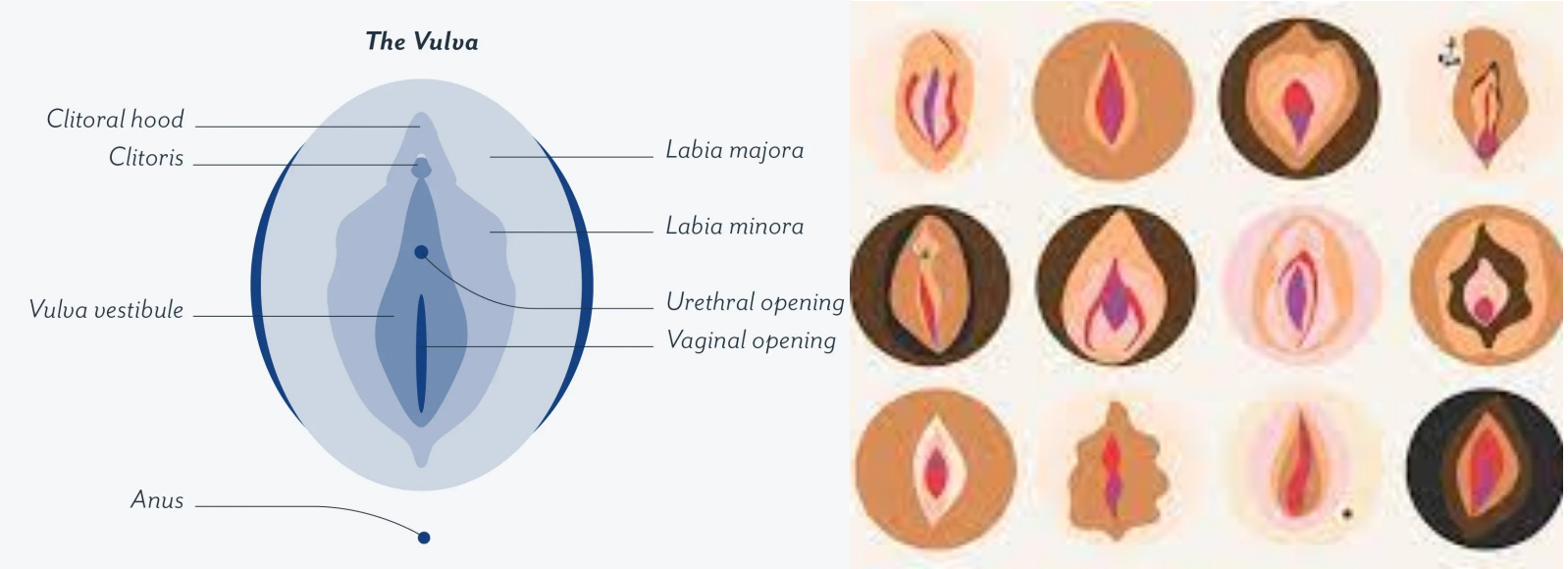
Vulva Anatomy www.helloclue.com
Vulvas www.helloclue.com
Cervix (feel like the tip of your nose, typically located in the back of your vagina, donut
like in shape):
Reproductive System: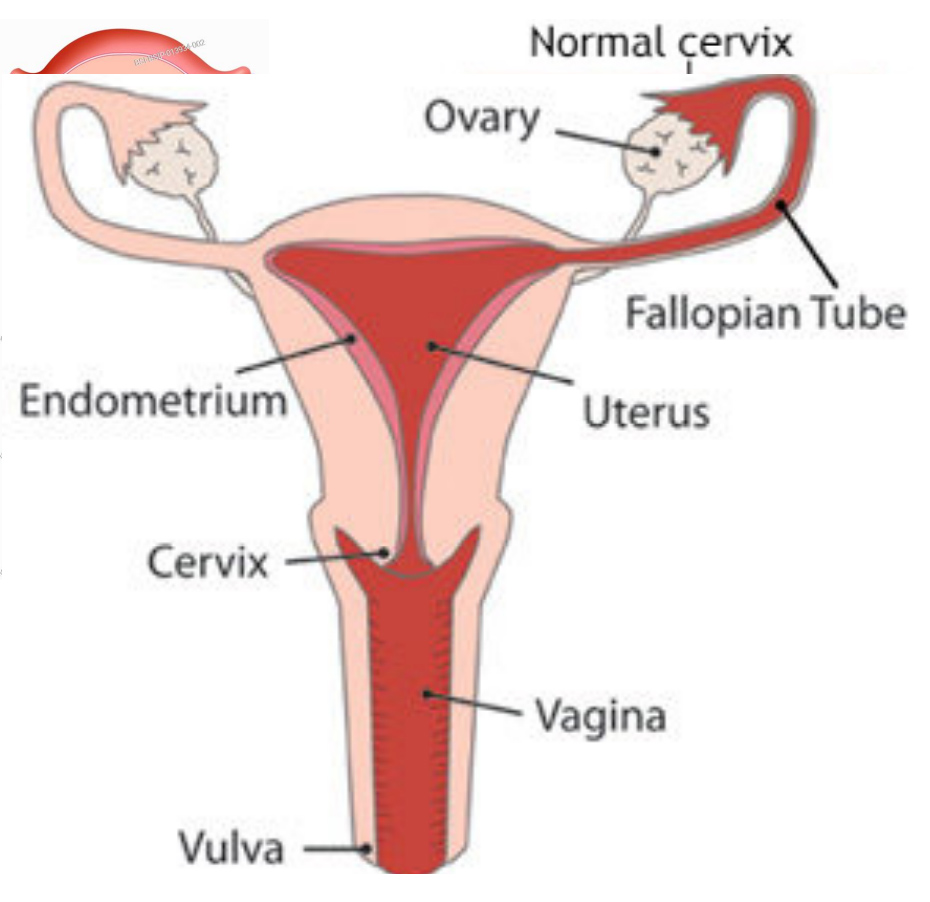
Coming soon
The swimmers find out of town meets a lot of fun and it is a great bonding experience for individual teams as well as for the club.
When competitions are out of town, the club usually plans all aspects of the trip: ransportation, hotel booking, and schedules. However, there may be competitions for which parents are required to drive their swimmer and / or make their own arrangements for accommodation. A basic outline of travel plans is shared at the season start and a mandatory parent information meeting is held about two weeks before each competition, where trip plans and detailed itinerary are shared.
Please label all clothing, especially club clothing…there are dozens of suits, pants and t-shirts that
are identical!!
HIGHLIGHTED ITEMS ARE “MUST HAVES” (i.e. Can’t compete without them).
Please triple check that these items are packed before leaving for the bus!
|
Uploaded
Failed
|
 |
Nepean Artistic Swim Club is committed to ensuring digital accessibility for people with disabilities. We are continually improving the user experience for everyone and applying the relevant accessibility standards.
The Web Content Accessibility Guidelines (WCAG) defines requirements for designers and developers to improve accessibility for people with disabilities. It defines three levels of conformance: Level A, Level AA, and Level AAA.
Nepean Artistic Swim Club is making constant efforts to improve the accessibility of its site and services in the belief that it is our collective moral obligation to allow seamless, accessible, and unhindered use for those of us with disabilities.
We aim to make all pages and content on https://nepeansynchro.com accessible, but some content may not yet fully meet the highest accessibility standards. This could be due to challenges in identifying the most suitable technological solution.
We may revise this Statement periodically to reflect improvements or changes to our accessibility practices.
We welcome your feedback on the accessibility of Nepean Artistic Swim Clubwebsite. Please let us know if you encounter accessibility barriers on our website: https://nepeansynchro.com
E-mail: clubadmin@nepeansynchro.com
We try to respond to feedback within 3–5 business days.
This statement was created on 19/05/2025.